
Romeo & Juliet Vanilla: Selling Homemade Madagascar Vanilla Extract
Jeff's friend Romeo (from Madagascar, married to Alecia — Jeff calls them Romeo and Juliet) wants to sell homemade vanilla extract made by steeping Madagascar vanilla beans in purchased vodka. This page covers what the law actually requires to sell it in the US, with a Utah focus, plus three bottle-label design concepts for the brand.
This is research, not legal advice. The alcohol angle is the part most people get wrong, so Romeo should confirm the TTB and Utah points with a lawyer or accountant before taking money.
The idea in one paragraph
Romeo steeps Madagascar vanilla beans in store-bought vodka, bottles the result, and sells it as vanilla extract. The product itself is simple and well understood. The complications are regulatory, not culinary: vanilla extract is legally defined by the FDA, it is about 35% alcohol by volume, and that alcohol content pulls in a second set of federal and state rules that most home food sellers never have to think about.
The FDA standard of identity: what "vanilla extract" legally means
Under 21 CFR 169.175, vanilla extract is "the solution in aqueous ethyl alcohol of the sapid and odorous principles extractable from vanilla beans." To use the name "vanilla extract" (or "extract of vanilla"), the product must meet two hard numbers:
- At least 35% ethyl alcohol by volume
- At least one unit of vanilla constituent per gallon — one unit is 13.35 ounces of vanilla beans at 25% moisture (21 CFR 169.3(c))
That bean-to-liquid ratio is the classic "single-fold" (1X) extract. A double-fold (2X) extract uses two units per gallon. Optional ingredients allowed by the standard are glycerin, propylene glycol, sugar (including invert sugar), dextrose, and corn syrup.
Two things follow from this:
- The alcohol is not optional. A product under 35% alcohol cannot legally be called vanilla extract; under 21 CFR 169.177 it is "vanilla flavoring" instead. Vodka at 80 proof (40% ABV) works as a base, but the finished product after the beans are added and any dilution must still test at 35% or higher.
- The name is protected. "Pure vanilla extract" on the label is a claim that the product meets the standard. If it doesn't, the product is misbranded under the Federal Food, Drug, and Cosmetic Act.
The alcohol angle: TTB, excise tax, and drawback
This is the most important section, because vanilla extract at 35%+ ABV sits in the same alcohol range as many distilled spirits — yet it is sold in grocery stores, not liquor stores. Here is why, and what it still costs.
Why it is a food, not a liquor, on the shelf
The Alcohol and Tobacco Tax and Trade Bureau (TTB) treats flavoring extracts as nonbeverage products. A vanilla extract is a food/flavor product that happens to contain alcohol; it is not an alcoholic beverage, so it does not need a TTB beverage permit, COLA label approval, or the Surgeon General's health warning that appears on beer, wine, and spirits. The key condition is that the product must be unfit for beverage purposes — in practice, vanilla extract qualifies because of its intense vanilla flavor concentration, but TTB's Nonbeverage Products Laboratory (NPL) can ask for a manufacturer's technical data sheet and a sample at any time, and any product at 0.5% ABV or more must be unfit for beverage purposes.
Excise tax still applies — then mostly comes back
- The federal excise tax on the vodka is paid when the vodka is bought. There is no way around this: federal excise tax applies even when the final use is non-beverage.
- Most of it can be claimed back through "drawback." Under 26 U.S.C. 5114 and 27 CFR Part 17, a manufacturer of a nonbeverage product (MNBP) that uses tax-paid distilled spirits can claim a refund of most of the excise tax, once TTB's Nonbeverage Products Laboratory approves the formula as unfit for beverage purposes.
- The process: register as a manufacturer of nonbeverage products, submit the formula on TTB Form 5154.1 (or electronically through Formulas Online), then file drawback claims on TTB Form 5620.8 with supporting data on Form 5154.2.
- Practical note for a small seller: the drawback paperwork is real administrative work, and the tax at stake is modest at hobby scale — federal excise tax on distilled spirits is $13.50 per proof gallon, so a 750 ml bottle of 80-proof vodka carries about $2.66 in federal excise tax. At small volumes, many sellers simply absorb the tax baked into the retail vodka price and skip the drawback claim. That is a business decision, not a compliance violation — the tax was already paid when the vodka was purchased. But if Romeo scales up and starts buying spirits in bulk, the drawback becomes worth doing, and at that point he also needs to check whether buying spirits for manufacturing triggers TTB qualification as a distilled spirits plant or rectifier — another reason to get a lawyer involved before scaling.
Buying the vodka
Romeo is not distilling anything, so he does not need a distiller's permit. He buys tax-paid vodka at retail like any consumer. One caution: in Utah, spirits are sold only through state liquor stores or package agencies (see the Utah section below), and buying in bulk for resale-as-an-ingredient is still just retail purchase — but he should keep receipts, because they are the paper trail for both the drawback claim and the business's cost records.
Utah: the good news and the two paths
Utah liquor law explicitly excludes extracts
Utah Code 32B-1-102(4)(c) defines "alcoholic product" as a product containing at least 0.5% alcohol by volume — but then expressly excludes "an extract" from that definition. (The one exception is an extract used as a flavoring in the manufacturing of an alcoholic product.) That means vanilla extract is not an alcoholic product under Utah law, so Romeo does not need a Department of Alcoholic Beverage Services (DABS) license to sell it, and it is not confined to state liquor stores. This is why grocery stores in Utah can sell vanilla extract off the shelf.
Utah home-food rules: vanilla extract is explicitly allowed under cottage food registration
The Utah Department of Agriculture and Food (UDAF) lists "Vanilla Extract" by name on its permitted cottage food products list. That is the single best piece of news in this research: Romeo does not need a commercial kitchen to start.
Utah has two home-kitchen paths, and they are not interchangeable:
| UDAF cottage food registration | Home Consumption and Homemade Food Act | |
|---|---|---|
| Law | Utah Code 4-5-501, rule R70-560 | Utah Code 4-5a |
| What you need | Food handler permit, UDAF application with recipes, pre-operational kitchen inspection, registration fee (~$100 registration + ~$100 plan review) | A municipal business license only — no UDAF registration, no inspection |
| What you can sell | Only shelf-stable foods on UDAF's permitted list — vanilla extract is on it | Almost any food except meat and raw dairy |
| Where you can sell | Direct to consumers, or to Utah stores for resale; in-state only | Direct to the end consumer, in person, at an agreed location; never to stores or restaurants; in-state only |
| Label | "Home Produced" in bold 12-point type on the principal display panel, plus full FDA-style labeling | Producer name and address, allergens, and the statement "Not for Resale — Processed and prepared without state or local inspection" |
Recommendation: register under the UDAF cottage food program. It is the only path that allows wholesale to stores, and vanilla extract is explicitly permitted there. The Homemade Food Act is a gray area for this product anyway: the Act covers food "prepared for use as food or nonalcoholic drink," and a 35% alcohol extract arguably falls outside that definition. UDAF registration avoids the argument entirely.
Limits that apply either way:
- Sales only within Utah. Neither program allows interstate shipping — selling online to customers in other states means leaving the cottage-food framework and operating as a licensed food manufacturer.
- No sales to restaurants or food service under the Homemade Food Act; under cottage registration, a food establishment may buy it only if there has been no intervening storage or transfer (Utah Admin. Code R70-560-7(8)).
- A local business license is required under both paths.
Federal food rules that apply once he sells
FDA food facility registration
Under 21 U.S.C. 350d and 21 CFR Part 1, Subpart H, any facility that manufactures, processes, packs, or holds food for consumption in the US must register with FDA. Registration is free and done online through FDA Industry Systems; it must be renewed every two years between October 1 and December 31 of even-numbered years. There is an exemption for retail food establishments — roughly, a business whose direct-to-consumer food sales exceed its sales to all other buyers — so a purely direct-sales cottage operation may qualify as exempt, but the exemption disappears the moment wholesale becomes the bigger channel. Registration is not approval; it just tells FDA who and where the facility is.
FSMA preventive controls
A registered facility is subject to the Food Safety Modernization Act's preventive-controls rule for human food (21 CFR Part 117), including a written food safety plan. Very small businesses can meet modified requirements as a "qualified facility" by submitting an attestation to FDA. At cottage scale this is mostly documentation — a hazard analysis, sanitation procedures, and supplier verification for the beans and vodka — but it should not be skipped.
Labeling (21 CFR Part 101)
Every bottle needs:
- Statement of identity: "Vanilla Extract" (or "Extract of Vanilla") on the principal display panel — 21 CFR 101.3
- Net quantity: e.g. "4 fl oz (118 mL)" — 21 CFR 101.7
- Ingredient statement: ingredients in descending order by weight, e.g. "Ingredients: Vodka, Madagascar vanilla beans" — 21 CFR 101.4. Note: if the vodka is a single ingredient spirit, list it as "alcohol" or by its common name; do not invent a fancier name.
- Name and place of business: manufacturer/packer name and address — 21 CFR 101.5
- Nutrition Facts: required unless an exemption applies. Small businesses may qualify for the small-business nutrition labeling exemption (fewer than 100 full-time employees and fewer than 100,000 units sold per year, with a filed notice) — but the exemption is lost if any nutrient content claim is made on the label. Vanilla extract is nearly calorie-free per teaspoon, so a panel is cheap to produce and removes the question.
- Allergens: vanilla is not one of the nine major food allergens, so no allergen declaration is required — but if the kitchen also handles allergens, a voluntary "may contain" statement is honest labeling.
- Cottage food marking: "Home Produced" in bold 12-point type on the principal display panel (Utah rule R70-560-6).
What not to put on the label: do not claim the product is "non-alcoholic," do not hide the alcohol content, and do not make health claims. "Pure" is fine — it is part of the standard name's common usage — as long as the product meets the standard of identity.
Selling beyond Utah
The moment Romeo sells across state lines — an Etsy shop shipping to California, a grocery chain outside Utah — he leaves the cottage-food world behind and becomes an FDA-registered food manufacturer subject to full FSMA preventive controls, with no retail-establishment exemption. The TTB nonbeverage-product analysis does not change, but the state-by-state picture does: every destination state has its own alcohol and food rules, and some states do not exempt extracts from their liquor laws the way Utah does. Interstate expansion is a "get a food lawyer first" moment, not a "list it on Etsy and see" moment.
Business basics checklist
- Register the business name and get a Utah business license (city/county) and an EIN
- Food handler permit for everyone who touches the product
- UDAF cottage food registration, with the vanilla extract recipe submitted for approval
- FDA facility registration (or document the retail-establishment exemption)
- Product liability insurance — a food business without it is one bad bottle away from a personal financial problem
- Keep batch records: bean source and lot, vodka brand and purchase receipts, steeping dates, bottling dates, and bottle counts per batch
- Trademark check on the brand name before printing labels
- If the beans come directly from Madagascar, check import rules: vanilla beans are a USDA/APHIS-regulated agricultural import, and buying through an established US importer is far simpler than importing directly
The brand: Romeo & Juliet Vanilla Co.
The business name is Romeo & Juliet Vanilla Co. — it uses the couple's own story (Jeff calls them Romeo and Juliet) as the brand, which is memorable, personal, and true. The tagline writes itself: a love story in every bottle. Three label directions were designed, all for a 4 fl oz amber glass bottle:
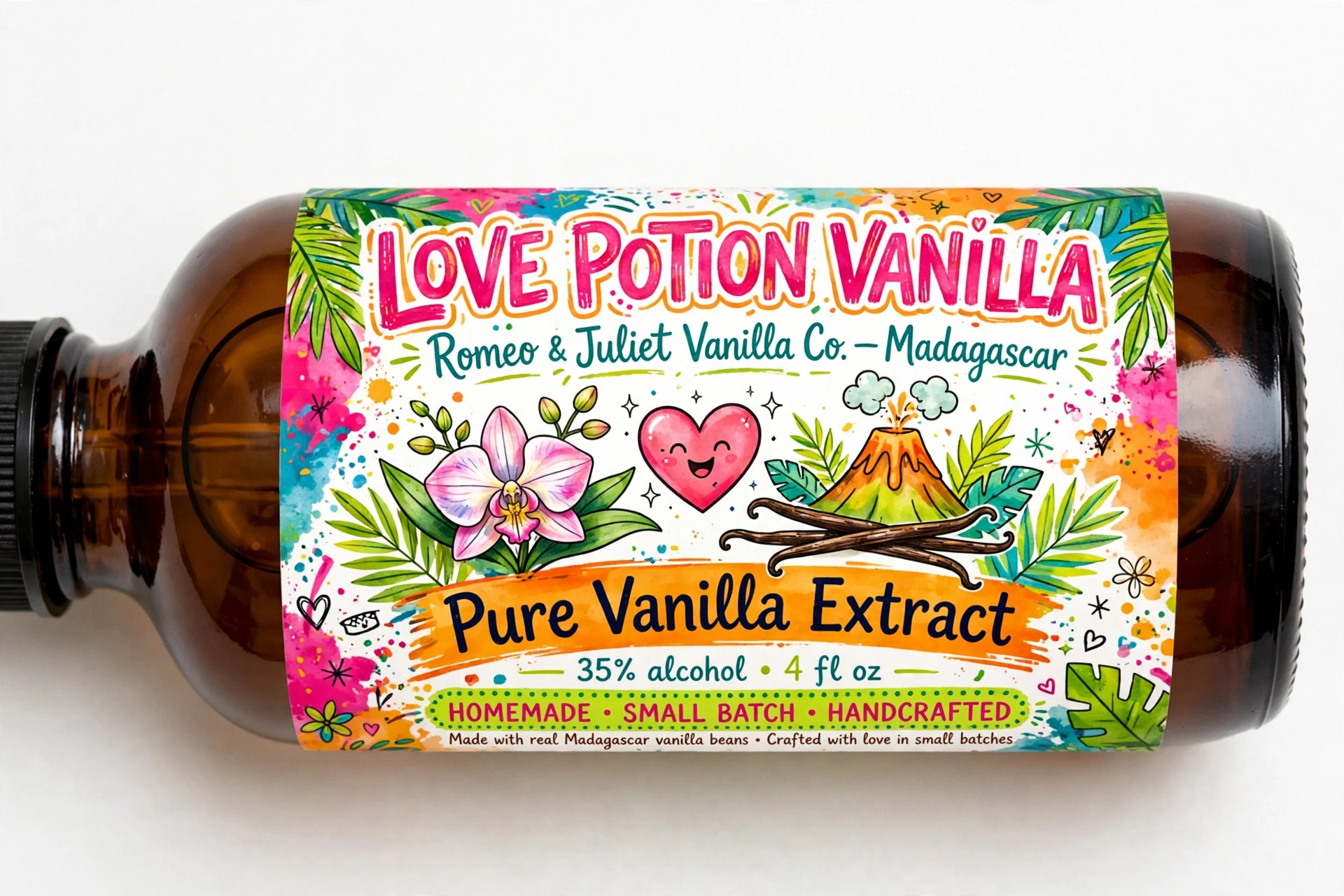
1. The fun one: "Love Potion Vanilla"
Bright, loud, and impossible to miss on a farmers-market table. Hot pink bubble lettering spells out LOVE POTION VANILLA, with "Romeo & Juliet Vanilla Co. — Madagascar" underneath in teal script. A smiling cartoon heart sits between a pink vanilla orchid and a little erupting volcano, with palm leaves, paint splatters, and vanilla pods scattered around the edges. An orange brush-stroke banner carries "Pure Vanilla Extract — 35% alcohol, 4 fl oz," and a green dotted strip at the bottom reads "Homemade • Small Batch • Handcrafted." Best for: farmers markets, gift shops, and social-media-first selling, where the bottle has to stop a scrolling thumb or a passing shopper.
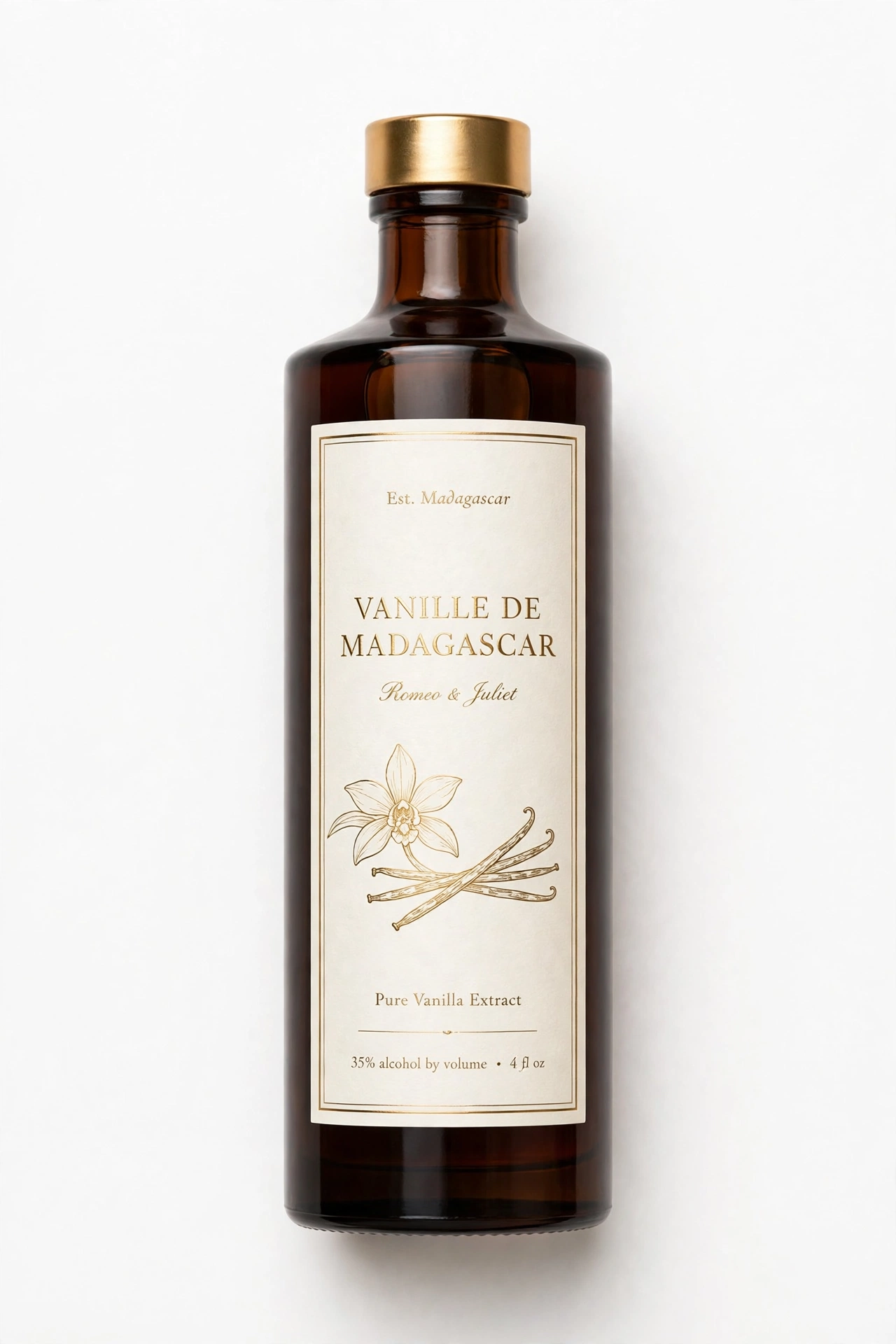
2. The classy one: "Vanille de Madagascar"
Cream and gold, French-apothecary elegance. "Vanille de Madagascar" in refined gold serif capitals, with "Romeo & Juliet" in script below and "Est. Madagascar" above. A delicate gold line drawing of a vanilla orchid and crossed bean pods is the only illustration, framed by a thin double gold border with generous white space. A gold screw cap completes the look. Best for: specialty food stores, gift baskets, wedding favors, and a premium price point — the bottle looks like it belongs next to the good olive oil.
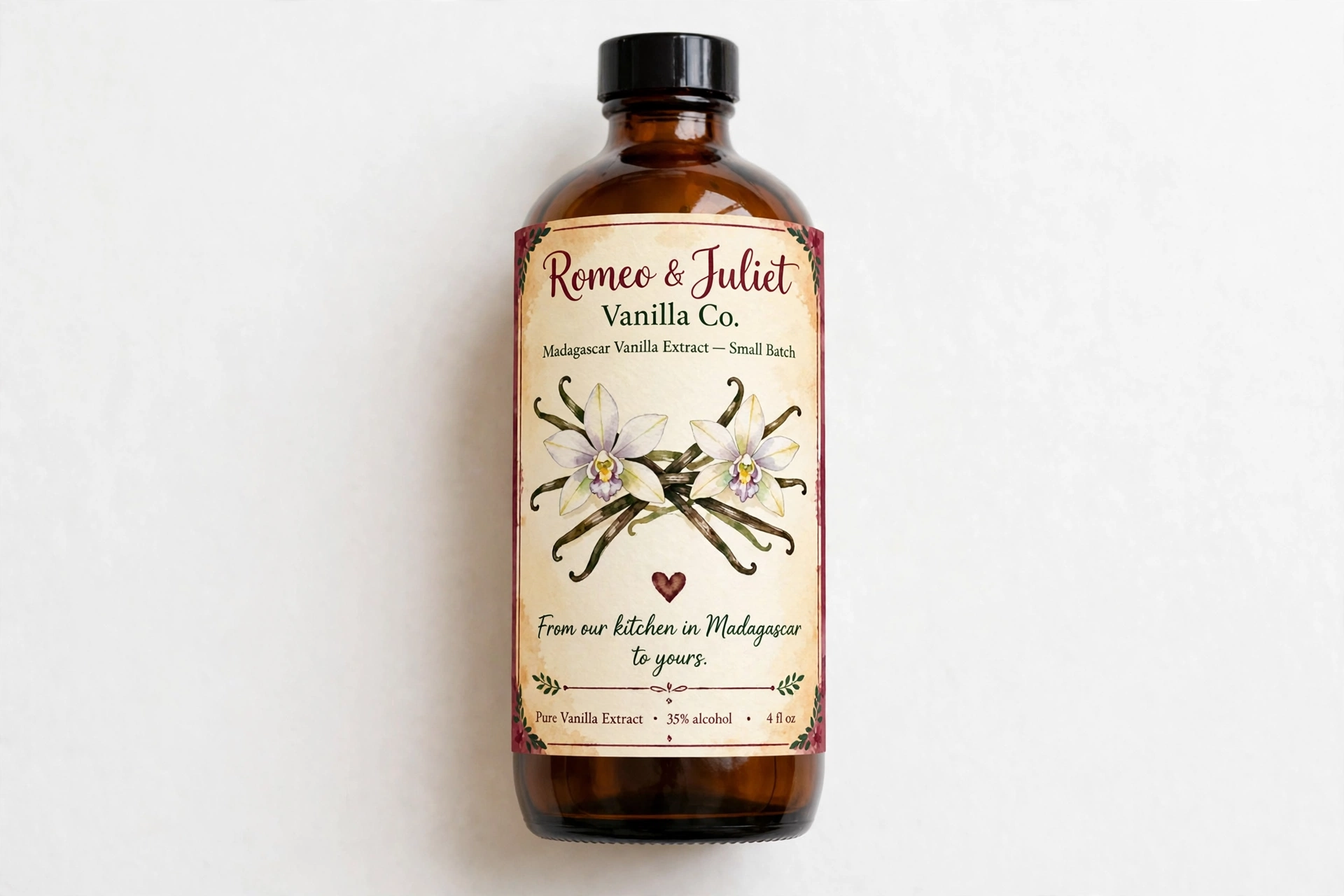
3. The middle one: "Romeo & Juliet Vanilla Co."
Warm, storybook charm that splits the difference. Burgundy script for "Romeo & Juliet," forest-green serif for "Vanilla Co.," on a parchment-cream label with a burgundy border. Two watercolor vanilla orchids cross over a bundle of bean pods, a small burgundy heart sits below, and the line "From our kitchen in Madagascar to yours." anchors the label. Best for: the everyday brand — friendly enough for a market stall, polished enough for a store shelf, and the easiest of the three to live with as the business grows.
Recommendation: launch with the middle label as the main brand and use the fun "Love Potion" design as a limited edition or gift version. The classy design is the right call if Romeo wants to charge a premium and sell through specialty stores.
Bottom line
- The product is legal to make and sell from a home kitchen in Utah — vanilla extract is explicitly on UDAF's permitted cottage food list, and Utah liquor law expressly excludes extracts from the definition of "alcoholic product."
- The path is UDAF cottage food registration, not the Homemade Food Act, because it allows store sales and sidesteps the Act's "nonalcoholic drink" wording.
- The recipe must hit the FDA standard: at least 35% alcohol and at least 13.35 oz of beans per gallon, or it cannot be called vanilla extract.
- The alcohol tax is already paid in the price of the retail vodka; TTB drawback can recover most of it at scale, but the paperwork only pays off once volume grows.
- Stay in Utah until a lawyer blesses interstate sales.
- Get insurance and keep batch records from day one.
Sources
- FDA / eCFR: 21 CFR 169.175 (vanilla extract), 169.177 (vanilla flavoring), 169.3(c) (unit of vanilla constituent) — law.cornell.edu/cfr/text/21/169.175
- TTB: Vanilla Extracts and Vanilla Flavors — ttb.gov/scientific-services-division/dbmenu8sub2
- TTB: Nonbeverage Drawback Alcohol — ttb.gov/scientific-services-division/nonbeverage-drawback-alcohol
- FDA: Guidance for Industry — Registration of Food Facilities, Small Entity Compliance Guide (May 2018) — fda.gov/media/85098/download
- Utah Code 32B-1-102 (alcoholic product definition; extracts excluded) — le.utah.gov
- UDAF: Cottage Food Production (permitted products list, including vanilla extract) — ag.utah.gov/regulatory-services/cottage-food-production/
- Utah Code 4-5-501 and Utah Admin. Code R70-560 (cottage food); Utah Code 4-5a (Home Consumption and Homemade Food Act)
Researched November 17, 2026. Regulations change; confirm current rules with UDAF and TTB before selling.
No comments to display
No comments to display